On this page
1. Getting Started
Digital Longbox is a personal comic collection manager. It scans the CBZ, CBR, and PDF files you already have, figures out the series and issue number for each one, and organizes everything into a clean, browsable library — without moving, renaming, or altering your original files.
The typical setup is three steps:
- Add a library — point Digital Longbox at the top-level folder where your comics live.
- Run a scan — Digital Longbox reads your files and identifies series, issue numbers, and metadata.
- Read, or turn on the server — read right in the app, or enable Server mode to make your library available to Longbox Reader on your phone or tablet.
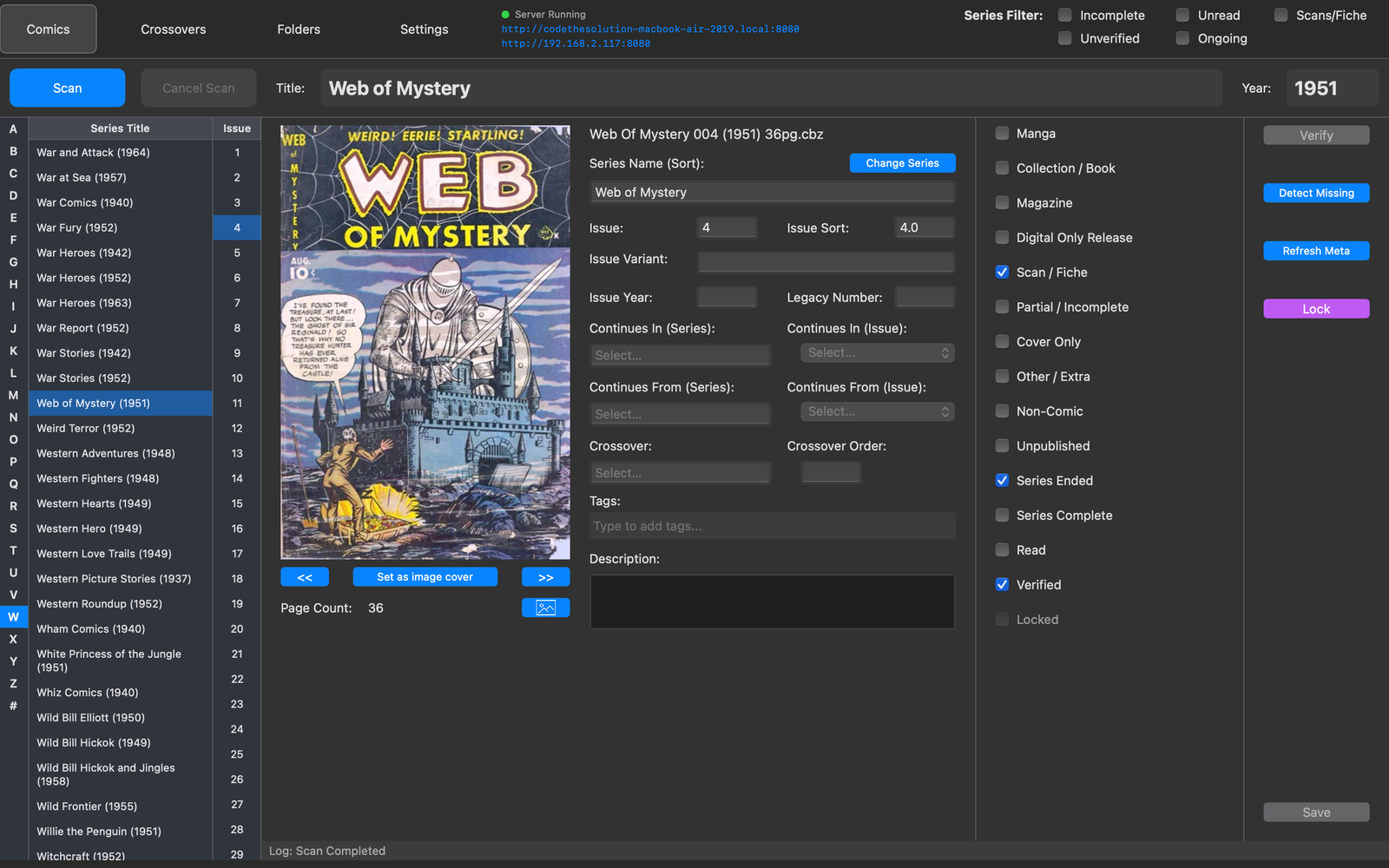
About the covers you see in these screenshots: every comic pictured on this page is a public domain title from the Comic Book Plus archive — a free, volunteer-run library of tens of thousands of legally public domain comics. We're grateful for the collection, and if you like what you see here, it's well worth exploring (and supporting) directly.
2. Organizing Your Collection
Digital Longbox reads your existing folder structure to figure out how your comics are organized, so a little bit of consistent naming goes a long way toward accurate matching.
One series per folder
Keep each series in its own folder, with the issue files directly inside it. A folder name that includes the series name and, ideally, its start year in parentheses gives the most reliable match:
Amazing Spider-Man (1963)/Saga (2012)/
Digital Longbox pulls the four-digit year out of the parentheses automatically and uses the remaining text as the series title.
Folder and file naming symbols
Because colons ( : ) and slashes ( / ) can't be used in folder or file names on most systems, use these substitutions instead — Digital Longbox converts them back automatically when it builds the series name:
| Type this | Digital Longbox reads it as | Example |
|---|---|---|
- (space-hyphen-space) | Colon : | Batman - Year One → Batman: Year One |
-- (space-double hyphen-space) | Slash / | Cloak -- Dagger → Cloak / Dagger |
Excluding files and folders
Add (exclude) anywhere in a file or folder name and Digital Longbox will skip it entirely during scanning — the check is case-insensitive, so (Exclude) works too.
- Exclude a single file:
Amazing Spider-Man 042 (exclude).cbz - Exclude an entire folder and everything inside it:
Convention Sketchbooks (exclude)/
Files and folders that begin with a dot (hidden files) are also skipped automatically, along with a couple of known library-manager marker folders so they don't get scanned as comics.
Tip: Only files with a .cbz, .cbr, or .pdf extension are picked up during a scan — anything else in a library folder is ignored automatically, so you don't need to exclude non-comic files like cover art or notes unless you'd prefer they weren't visible in your folder browser at all.
3. Adding Libraries
A library is simply a top-level folder that Digital Longbox scans. You can add more than one — for example, separate libraries for different drives or different collections.
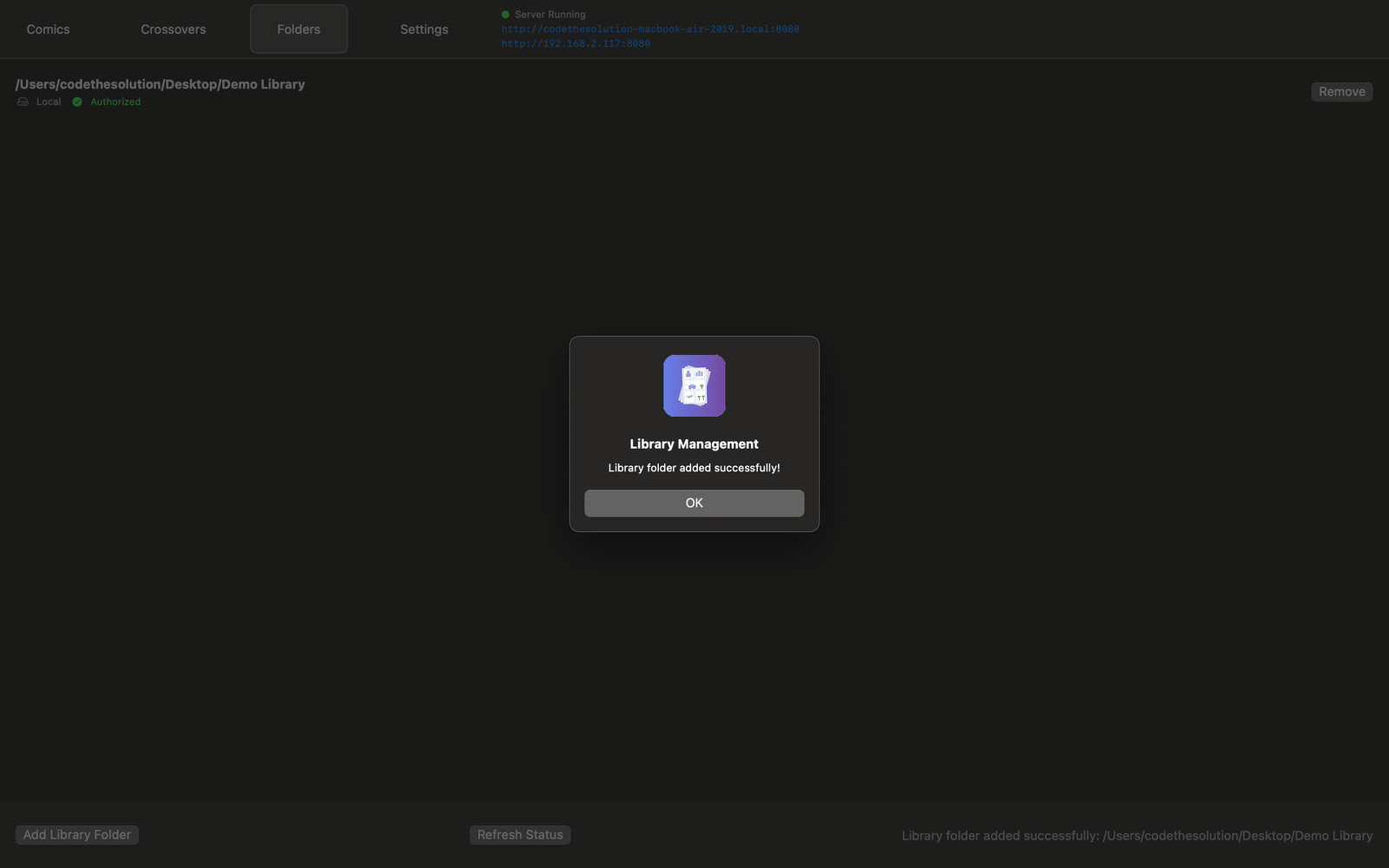
- Open Libraries from the main window.
- Click Add Library Folder.
- Choose the top-level folder that contains your series folders.
- Digital Longbox will remember this location and include it in future scans.
A note on macOS network shares (SMB): we don't recommend pointing a library at an SMB network share on macOS. SMB access from macOS can be noticeably slower than a local or externally-attached drive, and connections can drop mid-scan on larger collections — which may interrupt scanning or thumbnail generation partway through. For the most reliable experience, use a locally attached drive (internal, USB, or Thunderbolt) wherever possible.
4. Your First Scan
Before running your very first scan, take a minute to check your settings — a couple of choices are much easier to get right up front than to change after your whole library has already been matched.
Review the Comic Matching setting
Open Settings → Comic Matching and look at Enable metadata matching API. This is on by default, and it's what allows Digital Longbox to automatically identify series and issue numbers instead of leaving everything for you to enter by hand.
When this setting is enabled, a fingerprint (a hash) of each comic file — not the file itself — is sent to the matching service to look up series and issue metadata. No personally identifiable information is included in that request.
If you'd rather not send file fingerprints to the matching service, turn this off before your first scan. You can turn it back on later, but any comics already scanned while it was off will need a rescan to be matched. Please read the Privacy Policy before your first scan if you want the full detail on what is and isn't transmitted.
Why the matching service matters: automatic series and issue matching is the difference between a library that organizes itself and one you have to type in by hand, one comic at a time. The service improves over time because of the anonymous fingerprints and metadata contributed by scans — if you keep it enabled, your scans help make matching better for everyone, including future you.
Run the scan
- Go to Libraries and confirm the folders you want scanned are listed.
- Click Scan. Digital Longbox will walk through each folder, identify comic files, and match series and issue metadata.
- Larger collections — especially on a first scan — can take a while, particularly over a network share. Progress is shown as it works.
- Once the scan completes, your library grid will populate with covers, series names, and issue numbers.
5. Locking Metadata
If you edit a comic's metadata by hand — correcting a series name, fixing an issue number, adding your own notes — that custom data is submitted to the matching service for review. Some, all, or none of your changes may end up added to the shared database, depending on review.
Protect your edits: a future metadata refresh could overwrite the values you entered if the shared database doesn't yet reflect your change. To make sure that never happens, save your edits, then lock the issue. Locked issues are skipped by metadata refreshes and can't be edited again in the app until you unlock them.
- Open the comic and make your metadata edits (title, series, issue number, flags, etc.).
- Save your changes.
- Use the Lock control on the issue to mark it as locked.
Locking is per-issue, so you're free to lock only the comics where you've made changes you want to protect, and leave the rest open to future metadata refreshes.
6. Contributing to the API
Digital Longbox's matching service is built from community contributions. Every issue that gets verified and added to the shared database makes matching more accurate for every other collector — including you, the next time you rescan or add new comics.
Why this matters: the database only grows through submissions from collectors like you. A series or issue that isn't recognized today may match instantly on a future scan, once enough verified data has been contributed and processed.
If Enable metadata matching API is turned on (see Your First Scan), every save sends a copy of your comic's metadata to the server. Submitted data is reviewed before it's added to the shared database, so it may take some time to appear — how long depends on how many other submissions are being processed at the same time.
Finding unmatched issues
To quickly see which comics in your collection haven't been matched to the server yet, check the Unverified checkbox at the top of the screen. This filters your library down to just the issues where metadata isn't yet available on the server.
Verifying an issue
- Filter to Unverified and navigate to the comic you'd like to contribute.
- Click Verify.
- Digital Longbox saves the comic's metadata locally and sends a copy to the server for processing.
- The issue is marked as submitted and will no longer appear in your Unverified list, even while it's still being reviewed.
Verifying is entirely optional — Digital Longbox works the same either way — but the more collectors who contribute verified metadata, the more reliable matching becomes for everyone on future scans.
7. Streaming to Longbox Reader
Once your library is scanned, you can make it available to the Longbox Reader companion app on your phone or tablet:
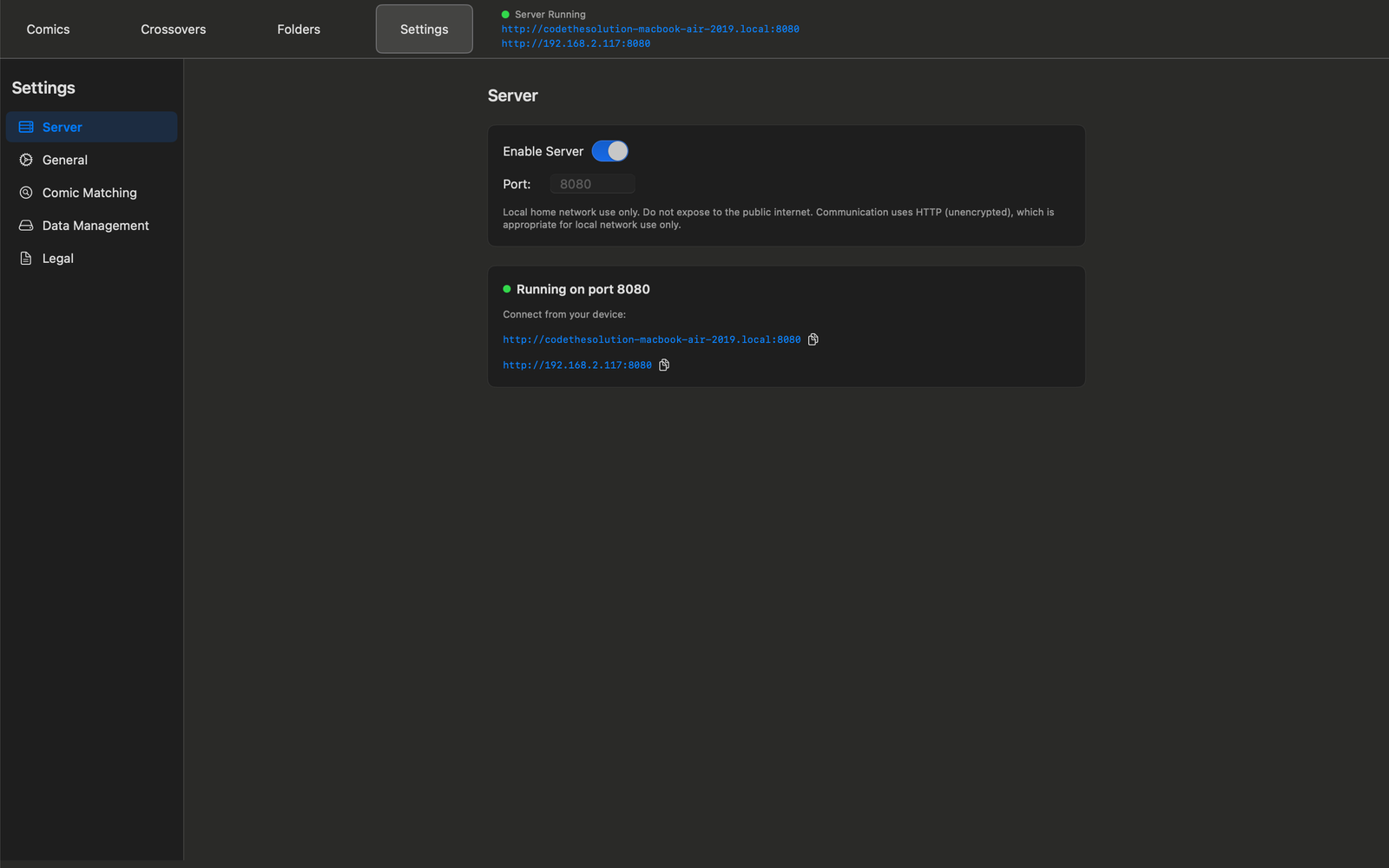
- Open Settings → Server.
- Turn on Enable Server. By default it runs on port
8080, but you can change this before starting the server if needed. - Open Longbox Reader on the same Wi-Fi network — it automatically discovers Digital Longbox and lists it as an available server. Tap it to connect; there's nothing to type. If it doesn't appear within a few seconds, tap Search Again in Longbox Reader.
The hostname and IP address Digital Longbox displays once the server is running aren't something you enter anywhere in Longbox Reader — they're shown for reference, and mainly useful for troubleshooting (for example, confirming that address loads in a web browser on the same network).
The server is designed for your home network only — communication uses plain HTTP, which is appropriate for a private home Wi-Fi network but should not be exposed to the public internet.
8. Troubleshooting
A comic isn't matching correctly
Double-check the folder naming — see Organizing Your Collection above. A missing or malformed year in parentheses, or a colon/slash that wasn't substituted, is the most common cause of a mismatch.
Longbox Reader can't connect to my server
Confirm both devices are on the same Wi-Fi network and that Enable Server is turned on in Digital Longbox. Longbox Reader discovers your server automatically — there's no address to type — so if it isn't showing up in Longbox Reader's server list, try Search Again there first. See the Longbox Reader connection guide for more.
Windows: the server shows as "running," but Longbox Reader still can't connect
This is almost always a firewall silently blocking the incoming connection — either Windows Defender Firewall or a separate third-party security suite — even though the server itself started without any error.
Why this is easy to miss: opening the server's address in a browser on the same Windows PC will often work even when every other device is blocked, because traffic to your own PC's address usually never crosses the network adapter a firewall inspects. The real test is connecting from another device — your phone or tablet — not from the PC itself.
If Enable Server is on but another device still can't connect, work through these in order:
- The first time the server starts, Windows needs one-time permission to open the network port. Digital Longbox requests this automatically and may briefly show a Windows administrator (UAC) prompt — accept it. This only happens once; later launches won't prompt again.
- If you have a third-party antivirus or security suite installed — Bitdefender, Norton, McAfee, Avast, Kaspersky, ESET, or similar — it runs its own firewall independently of Windows, and Windows-level permissions can't override it. Open that product's settings and add an allow rule for Digital Longbox, or for TCP port
8080(the default server port). - In that same antivirus app, check what type it thinks your current Wi-Fi network is. Security suites are typically far stricter about incoming connections on networks marked Public than on Home/Office or Private — set your home network to Home/Office if it isn't already, then restart the server.
- Confirm your phone or tablet and your PC are on the exact same network — not a guest Wi-Fi network, and not separate 2.4GHz/5GHz SSIDs, which some routers isolate from each other by default.
If Digital Longbox shows a warning dialog after starting the server that names a specific antivirus product, that's this exact issue — the fastest fix is to follow the guidance in that dialog directly. The dialog has a "don't show this again" option once you've resolved it, so it won't keep reappearing on future launches.
A scan seems to have stalled or stopped early
This is most often caused by a dropped connection to a network drive mid-scan. If you're scanning from an SMB share, see the note in Adding Libraries above.
9. Contact Support
Still stuck? Reach out and we'll help you sort it out.
10. Report an Issue / Feature Request
Found a bug, or have an idea that would make Digital Longbox better? Bugs and feature requests are tracked publicly so you can see what's already been reported.
- Search existing issues to see if it's already been reported.
- If not, report a bug or request a feature, and select Digital Longbox (macOS) or Digital Longbox (windows) from the app dropdown.